
Network
Site status & network outages
Real-time site availability derived from core signalling: which sites are down, since when, how many customers are affected — with hierarchy, history and a resolution workflow.
CETIN SK — production
Live
site availability computed from S1AP signalling — independent of vendor EMS
Impact-first
every outage carries an affected-customer count, so priority is obvious
Hierarchy
parent/child site relations show what a single failure really takes down
At a glance
Status: Live
Deployed at: CETIN SK — production
Domain: Network
Built with: S1AP / core alarms · Kafka · BitSwan pipelines · TESU
What it does
The application watches core signalling (S1AP and related alarm sources) and continuously derives which sites are actually up — vendor-independently, without waiting for an EMS to decide something is worth an alarm. Each detected outage is enriched with the site’s customer base, its parent/child relations and its baseband inventory, then tracked until resolution.
Why it matters
An alarm list answers “what is complaining?”. This board answers the question the NOC actually triages by: “who is offline, and how many customers does each of these represent?” The affected-customer count turns prioritisation from tribal knowledge into a sort order, and the site hierarchy makes cascade failures (one transmission site taking children with it) readable at a glance.
Because the same site-status feed powers TESU, a support agent looking up one complaining customer sees instantly that their whole site is down — and the NOC sees how many more calls are coming.
How it works
BitSwan ingestors stream S1AP and core alarm sources into Kafka.
Pipelines correlate the signalling into per-site availability states, debounce flapping, and attach customer counts and topology from inventory connectors (CROSS, SBR).
The status board and the per-site detail (location, basebands, 30-day history) are served as a BitSwan application, with the same data exposed over APIs for downstream tools.
Why it replicates
S1AP is S1AP. The derivation logic, the impact enrichment and the UI are operator-agnostic BitSwan modules; replication is a matter of connecting your signalling feed and your inventory.
From the live system
Screenshots
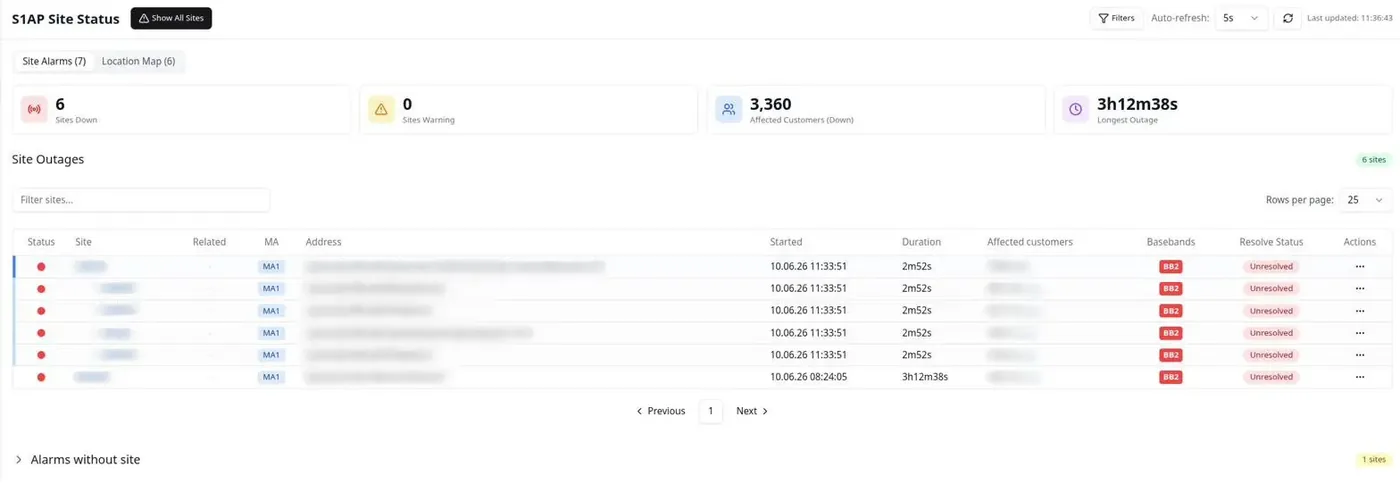
Site status board. Sites currently down with start time, duration and affected customers — in this view, 6 sites and 3,360 customers. Sorted by impact, not by alarm count.
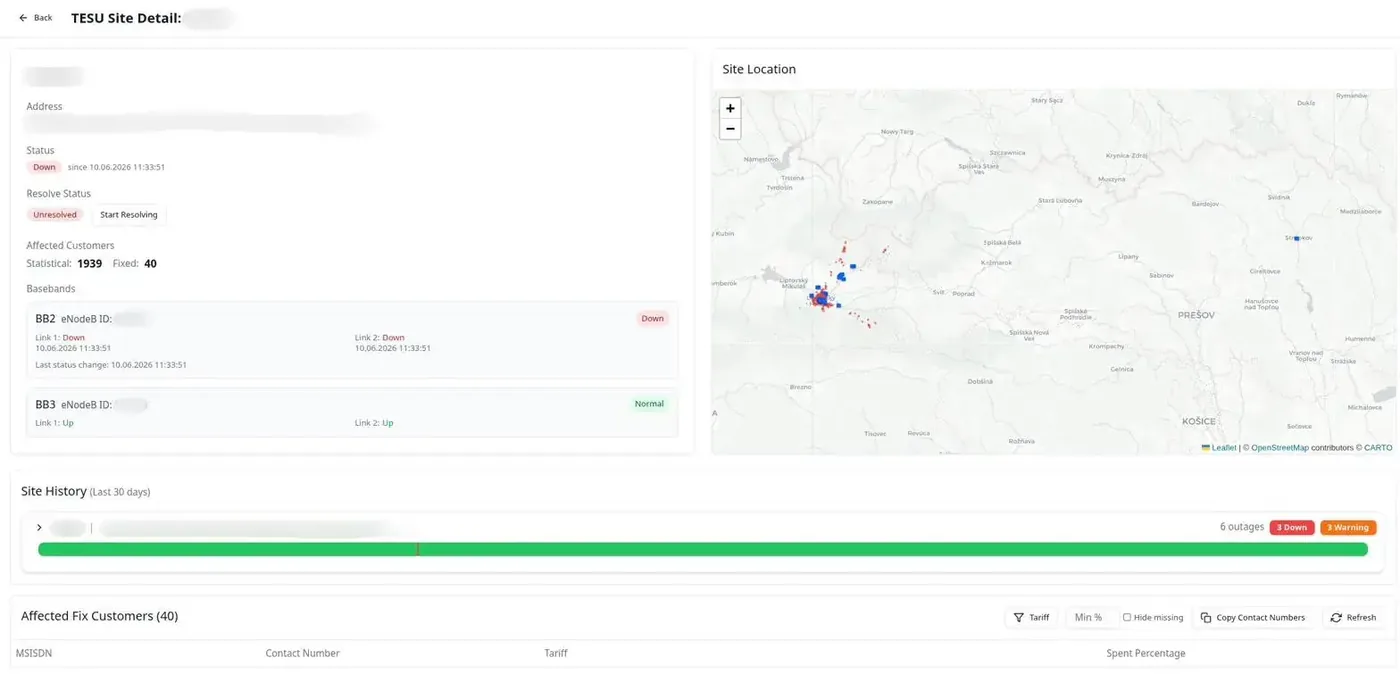
Site detail. One site with its location, basebands, affected customers and 30-day availability history — outage context without leaving the page.
Screenshots come from the production system and will be anonymised before public launch.
See it on your data.
A 60-minute walkthrough of the live use cases — and a frank conversation about which of them would land first on your network.